

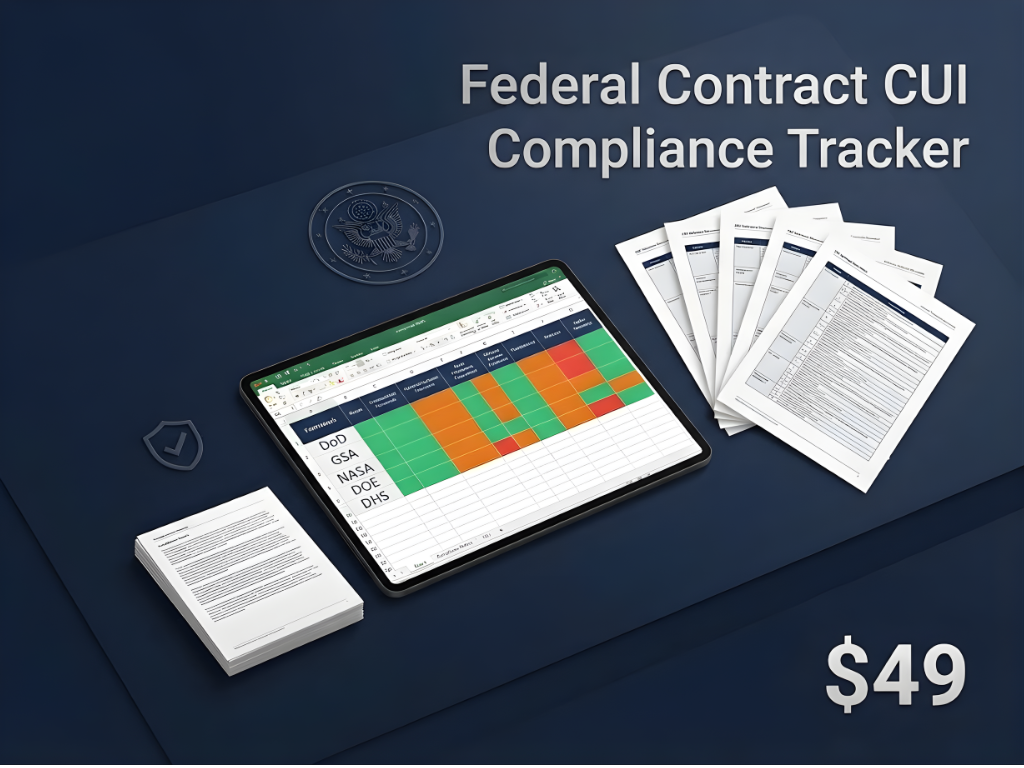
If you hold contracts with DoD and at least one civilian agency, you have a CUI compliance gap you probably have not mapped.
Most contractors have addressed DFARS 252.204-7012 and CMMC for their DoD work. What they have not done is verify what GSA, NASA, DOE, or DHS actually require on the contracts sitting in the same portfolio. Each agency applies a different framework, a different NIST revision requirement, and a different incident reporting timeline. GSA requires notification within 1 hour. DoD gives you 72 hours. The proposed FAR CUI Rule sets 8 hours for all federal contracts. If your incident response procedure runs on the DoD clock, you are already out of compliance on your GSA contract — and you will be out of compliance on every civilian contract the moment the FAR rule finalizes.
This workbook gives you a structured, single-afternoon process to inventory every active CUI-bearing contract, map it to its governing framework, identify the divergences that create audit exposure, and score your readiness across both NIST Rev 2 and Rev 3. The output is not a report — it is a live, auto-calculating workbook you continue to use as your contract base changes and the regulatory landscape shifts.
Complete the portfolio mapping in 2–4 hours. Walk away with an executive dashboard, a Rev 3 upgrade plan, and a prioritized gap list.
What’s Inside
6-Tab Interactive Excel Workbook (.xlsx)
- Contract Portfolio — Input layer for up to 50 active contracts; auto-populates applicable framework, NIST revision required, and incident reporting window per agency based on hardcoded agency data for DoD, GSA, NASA, DOE, DHS, and State
- Framework Applicability Matrix — Cross-reference view showing which compliance frameworks govern each contract: CMMC, DFARS 252.204-7012, GSA CIO-IT Security-21-112, proposed FAR CUI Rule; flags C3PAO assessment requirements, SPRS score obligations, and subcontractor flowdown applicability
- Rev 2 → Rev 3 Control Family Comparison — Pre-populated side-by-side reference for all 17 control families (14 original + Planning and Supply Chain Risk Management, both new in Rev 3) with net control count changes, new evidence requirements, ODP additions, and user-rated upgrade burden
- Agency Divergence Map — Pre-populated read-only matrix showing exactly where DoD, GSA, NASA, DOE, DHS, State, and the proposed FAR rule diverge across incident reporting windows, assessment methods, NIST revision requirements, SPRS scoring, and subcontractor flowdown rules
- Compliance Gap Tracker — Self-assessment tab covering all 16 active control families for both Rev 2 and Rev 3; auto-calculates compliance scores per family with traffic-light status indicators
- Executive Dashboard — Auto-generated portfolio overview: total contracts by agency, framework exposure summary, incident reporting risk flags, compliance scores by family, and top-priority gaps — no manual entry required
Plus 5 Standalone Reference PDFs:
- Companion Guide (8–10 pages) — Agency framework deep dives, incident reporting obligations, Rev 3 transition guidance, and FAR CUI Rule exposure analysis
- Example Completed Workbook Excerpt — 2–3 realistic tabs from a fictional contractor with DoD, GSA, and NASA contracts; shows what a populated workbook looks like before you build your own
- Agency Divergence Map — Print-ready standalone reference showing exactly how DoD, GSA, NASA, DOE, DHS, State, and the proposed FAR rule diverge across incident reporting windows, NIST revision requirements, C3PAO assessment obligations, SPRS scoring, subcontractor flowdown, CUI category specificity, and POA&M requirements; color-coded for at-a-glance risk identification
- Rev 2 → Rev 3 Comparison — Print-ready standalone reference for all 17 NIST 800-171 control families with net change counts, new evidence requirements, ODP additions, and upgrade burden ratings; includes a detailed key changes summary per family
- CUI Category Reference Guide (15 pages) — Covers all 11 CUI categories available in the workbook; each entry includes the definition, what qualifies, governing legal authorities, standard marking format, handling requirements across four dimensions (storage, transmission, access control, destruction), agency-specific policy notes, contractor action checklist, common mistakes, plus cross-reference matrix and incident reporting quick reference
- Quick-start README
What It Solves
- Framework confusion across agencies — You’re applying CMMC logic to contracts that are actually governed by GSA CIO-IT Security-21-112 or NASA NPR 2810.1. This workbook maps the right framework to each contract automatically.
- Incident reporting blind spots — Your shortest reporting window determines your actual compliance obligation. If any contract requires 1-hour notification, your IR procedure needs to be built to that standard — not 72 hours.
- No Rev 3 upgrade plan — Rev 3 introduces two new control families and expands Organization-Defined Parameters across nearly every existing family. The comparison tab shows your upgrade burden by family so you can prioritize before your agency mandates the transition.
- No portfolio-level view — Without a consolidated inventory, you cannot answer: how many contracts involve CUI, which require C3PAO assessment, which require SPRS scoring, which require flowdown to subs. This workbook produces that view in an afternoon.
- Unpriced FAR CUI Rule exposure — The proposed FAR rule would extend NIST 800-171 obligations to all federal CUI contracts, not just DoD. The framework matrix flags every contract in your portfolio that would be affected so you can quantify the compliance delta before the rule finalizes.
Key Features
- Hardcoded agency data for DoD, GSA, NASA, DOE, DHS, and State — applicable framework, NIST revision, and incident reporting window auto-populate from your agency selection
- Pre-populated Agency Divergence Map covering 7 compliance dimensions across 7 agencies/frameworks — no research required; also included as a standalone color-coded print-ready PDF
- Rev 2 vs. Rev 3 side-by-side comparison for all 17 control families with net change counts, new evidence requirements, and ODP flags — also included as a standalone reference PDF
- CUI Category Reference Guide PDF covering all 11 CUI categories: definitions, handling requirements, agency-specific policy divergences, contractor action checklists, and incident reporting timelines in one document
- Incident reporting window auto-flagged RED for 1-hour obligations (GSA, NASA, DOE, DHS) — the highest-risk divergence point for multi-agency contractors
- FAR CUI Rule exposure tracker flags every CUI-bearing contract that would fall under the proposed rule, giving you pre-finalization visibility into your civilian compliance gap
- Auto-calculated compliance scores with traffic-light dashboard — no manual scoring or formula-building required
- Covers up to 50 active contracts; supports mixed agency portfolios with any combination of the six supported agencies
- No macros required; Microsoft Excel 2016 or later
Who This Is For
- Compliance officers and IT directors at small-to-mid-size defense contractors with contracts spanning DoD and one or more civilian agencies
- Program managers responsible for contract-level compliance who need a cross-agency view but have no existing tool to produce it
- GovCon consultants managing multi-agency compliance portfolios and needing a repeatable scoping tool per client
- Contractors preparing for the proposed FAR CUI Rule who need to quantify their civilian contract exposure before it finalizes

Reviews
There are no reviews yet.